Is Red 40 (Allura Red) Bad for You? A Canadian Label Guide
“Red 40” is one of the most-searched food additives in North America — and one of the most confusing for Canadian shoppers, because it appears under a completely different name on Canadian labels. Here’s the short version up front: Red 40 is a permitted synthetic colour in Canada, on Canadian packages it’s called Allura Red, regulators disagree internationally on how to handle it, and whether you want it in your cart is a personal call. This guide gives you the full picture so you can make that call — and a way to enforce it automatically.
Short on time? Tarlo flags Allura Red and the whole dye family automatically on any Canadian barcode — free. The rest of this guide explains exactly what it’s flagging, and why regulators disagree about it.
What Red 40 is
Red 40 is a synthetic azo dye — a colour made from petroleum-derived chemicals rather than extracted from a plant, insect or mineral. It produces a bright, stable red that doesn’t fade with heat, light or acidity, which is exactly why manufacturers like it: it’s cheap, vivid and reliable in everything from candy to sports drinks.
It’s the most widely used synthetic food dye in North America, well ahead of the other common colours (Tartrazine/Yellow 5, Sunset Yellow/Yellow 6, Brilliant Blue/Blue 1).
What it’s called on a Canadian label
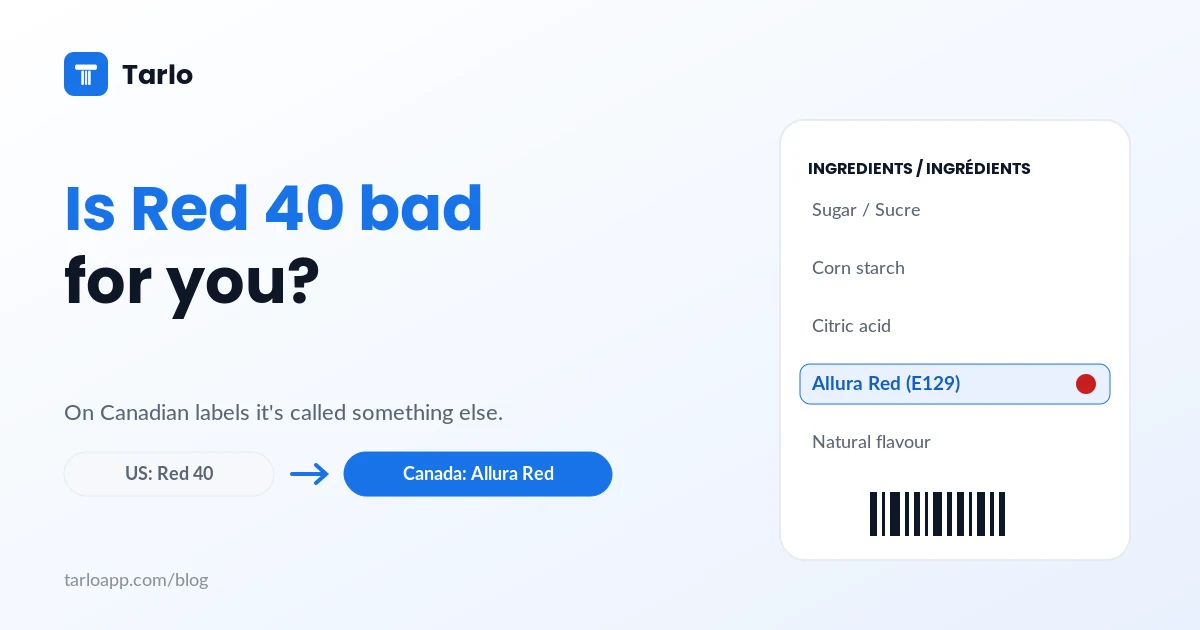
This is the part that trips people up. The US name is “Red 40” (FD&C Red No. 40). On a Canadian ingredient list, the very same dye appears as:
| Where | How it appears on the label |
|---|---|
| United States | Red 40, FD&C Red No. 40 |
| Canada (English) | Allura Red |
| Canada (French) | Rouge allura |
| Europe / E-number systems | E129 — look up any code |
So if you’ve been scanning Canadian ingredient lists for “Red 40” and not finding it, that doesn’t mean it isn’t there — it means you were looking for the wrong words. This US-vs-Canada naming gap applies across the synthetic colours, and it’s one of the most common reasons shoppers miss dyes they intend to avoid.
One piece of good news: since 2016, Health Canada requires every added colour to be named individually in the ingredient list. Before that, manufacturers could write the single word “colour” and stop there. Today Allura Red must be declared by name — which is what makes both manual label-reading and barcode-scanning apps able to catch it at all.
Where it shows up
Allura Red concentrates in a predictable set of categories: candy and gummies, freezies and popsicles, drink crystals and sports drinks, red-tinted cereals, icing, sprinkles and baking decorations, some flavoured yogurts and snack crackers, and — less obviously — things like red pill coatings and cough syrup. “Fruit-flavoured” and “berry” products are frequent carriers; the red rarely comes from fruit.
The less obvious carriers are the reason avoiding it by memory doesn’t really work. A cheese-flavoured cracker or a pickled product can carry it too.
What regulators say
- Health Canada permits Allura Red as a food colour, with limits on how much can be used in which categories, and considers it acceptable at those levels. Its position is that the colour is safe as regulated.
- The European Union also permits it — but with a twist that matters to a lot of parents: any food containing Allura Red (and five other colours) must carry the warning that it “may have an adverse effect on activity and attention in children.” That requirement followed the 2007 “Southampton Six” study.
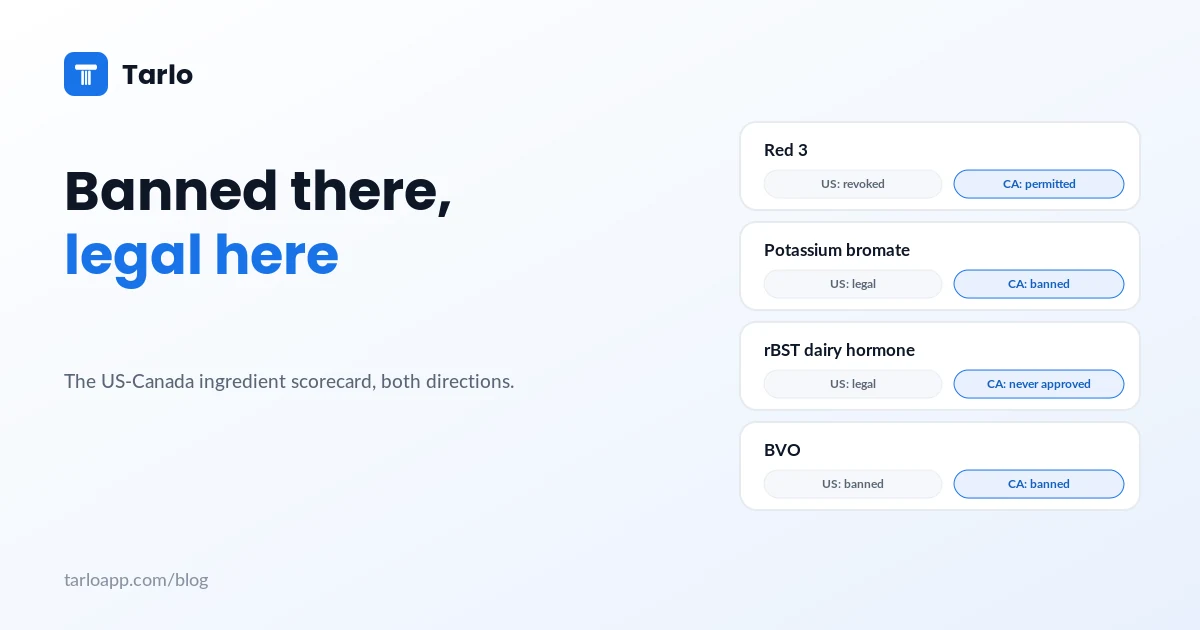
- In the United States, momentum has shifted (the full ban-status answer): California passed legislation targeting certain synthetic dyes in school food, the FDA revoked Red 3 (a different red dye) for food use in 2025, and several large manufacturers have announced reformulation plans away from synthetic colours.
Three sophisticated regulators, three different postures — permitted here, permitted-with-warning in Europe, actively being squeezed in the US. When experts split like that, the honest conclusion is that this is a judgment call, not a settled fact.
The behaviour question
The core scientific debate concerns children’s behaviour. The Southampton study found that mixtures of certain synthetic colours plus a preservative were associated with increased hyperactivity in some children; later reviews (including a 2021 assessment by California’s OEHHA) concluded that synthetic food dyes can affect activity and attention in some children, with sensitivity varying widely from child to child. Health Canada reviewed similar evidence and did not change its permissions.
Nobody credible claims every child is affected. The fair reading: a subset of children may be sensitive, there’s no easy way to know in advance if yours is one of them, and the cost of avoiding the dye is low. That asymmetry is why many families simply opt out.
Why some shoppers avoid it
The common reasons, none of which require the dye to be “proven harmful”: managing a child’s suspected sensitivity, following the EU’s precautionary lead, a general preference against synthetic colours when natural ones exist, or simply wanting fewer cosmetic additives. Avoiding Allura Red is a preference — a perfectly reasonable one — and that’s exactly the framing Tarlo uses: it will never tell you the dye is toxic, and it will never tell you it’s fine. It tells you whether the product in your hand meets the rule you set.
How to avoid it without reading every label
Manually, you’re scanning every ingredient list for three different strings — Allura Red, Rouge allura, E129 — plus the sibling dyes if you’re avoiding the whole family. Across a full cart, that’s genuinely tedious.
The faster way: in Tarlo, switch on the synthetic dyes rule once. Every scan then checks the product’s pre-parsed additive codes (language-independent, so it catches the French label too) plus the ingredient text, for Allura Red and its relatives — Tartrazine, Sunset Yellow, Brilliant Blue, Erythrosine. The verdict is a plain meets / doesn’t meet your rules, with the exact trigger named. When something fails, Tarlo shows dye-free alternatives on the same shelf, with real shelf prices.
To understand the mechanics behind that verdict, see how Tarlo turns a barcode into a verdict; for the wider labelling context, start with Canada’s front-of-package symbol — which, notably, says nothing about dyes.
Frequently asked questions
Is Allura Red banned anywhere?
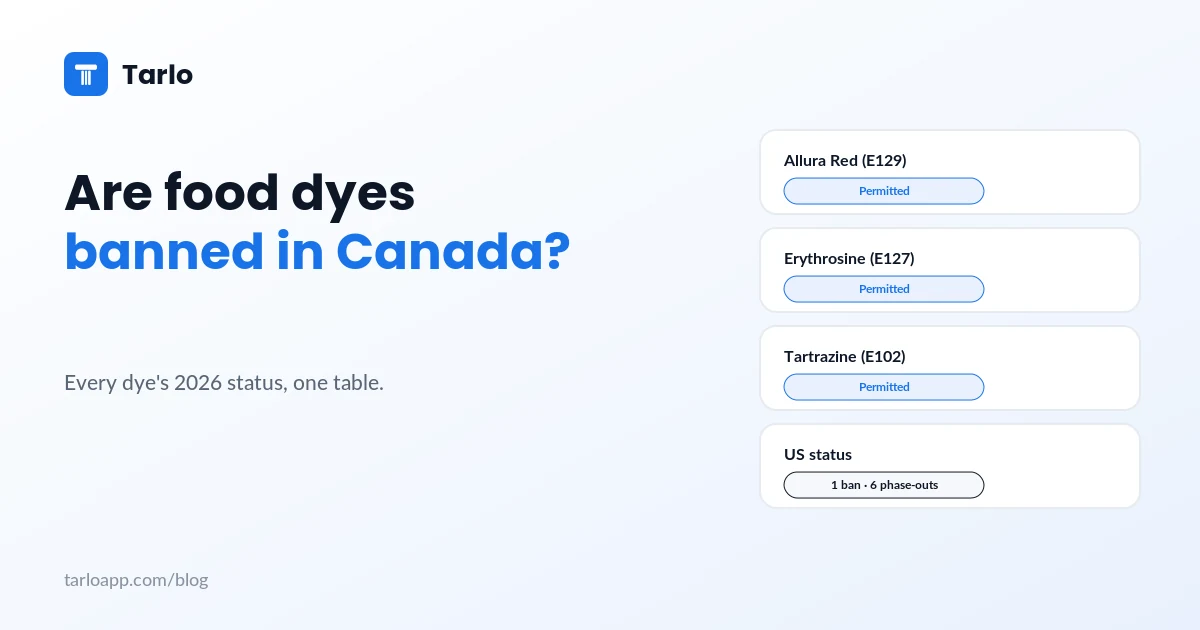
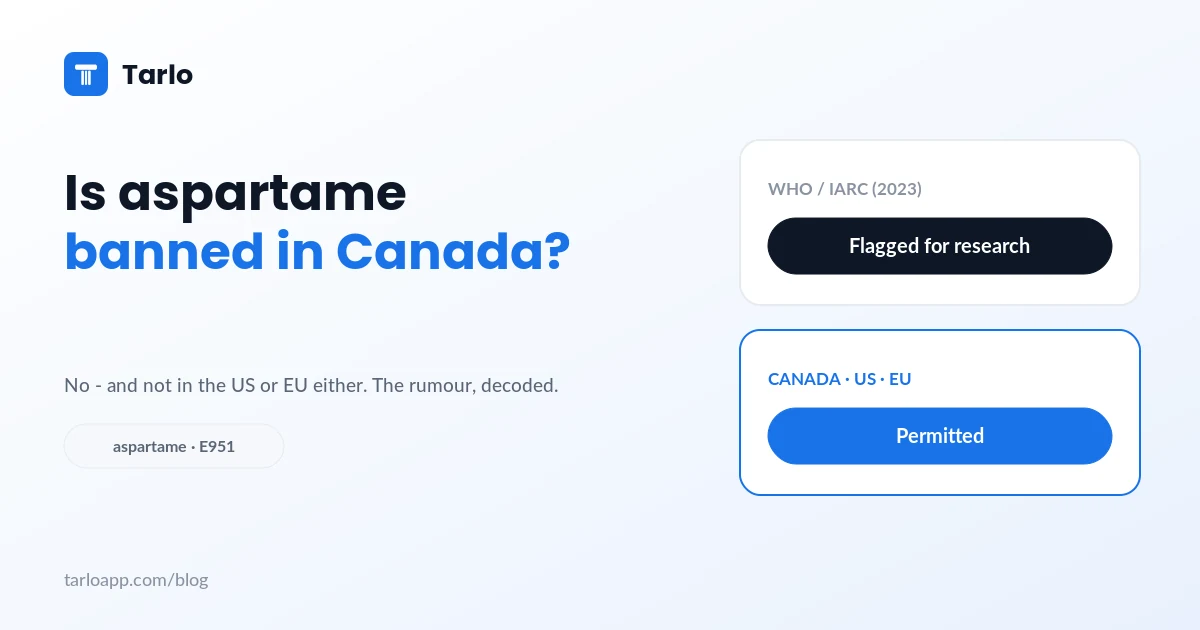
It’s not banned in Canada, the US or the EU. The EU requires the child-behaviour warning label; some countries restrict it in specific categories. (People often confuse it with Red 3 / Erythrosine, which the US FDA revoked in 2025 while Canada still permits it — a different dye.)
Is “natural colour” automatically better?
Not for everyone. Natural reds usually come from beet juice, paprika extract or carmine — and carmine (made from cochineal insects) is itself something some shoppers avoid, for allergy or dietary reasons. “Natural” answers one question, not all of them.
Does Allura Red appear in medicine and cosmetics?
Yes — pill coatings, syrups and cosmetics can contain it. Food labels are where Tarlo can help; for medications, check with a pharmacist.
How do I know if a Canadian product has it?
Look for Allura Red (English) or Rouge allura (French) in the ingredient list — it must be named since 2016 — or scan the barcode with Tarlo and let the dyes rule do it for you.
Sources
- Health Canada — Food colours: individual naming requirement and permitted colouring agents: canada.ca
- EU Regulation 1333/2008 — colour warning statements (Southampton colours).
- McCann et al., The Lancet (2007) — the “Southampton study”; California OEHHA (2021) — health effects assessment of synthetic food dyes.
- US FDA (2025) — revocation of Red No. 3 authorization for foods.
Tarlo reflects the rules you turn on and is for general information only — it is not medical or dietary advice. Regulatory details are Canadian and current as of the date above; always verify the product's physical label.